
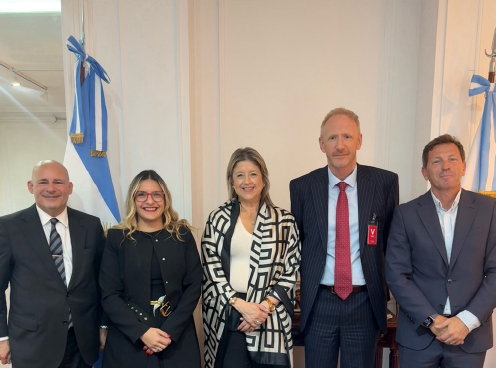
In December 2025, Forensic Justice was honored to conduct a one-week technical assistance visit to Argentina. The amended federal law on DNA databases is already in the implementation phase. Technical visits were conducted with the new Minister of Security, Mg. Alejandra Monteoliva, and her team, to discuss implementation strategies and activities. This was complemented by meetings at the National Gendarmerie, whose DNA laboratory and its Criminalistics Division is one of the key agencies for the national implementation of the new law, as well as a visit to the criminal investigation agency of the Buenos Aires Attorney General’s Office, which is leading the efforts to modify the DNA database law in force in Buenos Aires.
Justica Forense also attended the Regional Congress of Criminalistics and Forensic Studies,
Crypto-assets and Drug Trafficking (CRIPNAR) organized by the Ministry of Security and the Gendarmerie. This allowed Justicia Forense to present best practices for the implementation of DNA databases and to help Argentina establish the relevant institutional roles and responsibilities to ensure a robust implementation.
Finally, Forensic Justice spent three days in the Province of Santa Fe, meeting with experts from the Ministry of Security, the Attorney General’s Office, the Police and the Supreme Court. The Santa Fe Congress approved amendments to its DNA database law and the province now needs to push for the regulation of the database law and develop an inter-institutional implementation plan. Forensic Justice is committed to supporting Santa Fe in this vision. Simultaneously, Forensic Justice completed a detailed analysis of training and policy baselines for the Provincial Police Criminal Investigation Division to help define future training and modernization strategies, including how they will integrate better use of DNA evidence in criminal investigations.
Argentina has recognized the power of DNA databases to reduce impunity, decrease recidivism and increase the number of successfully solved crimes, while protecting innocent people from wrongful investigations and prosecutions. Its progressive and robust federal law, once fully implemented and complemented by strong provincial legislation, will have profound effects on crime and justice in the country and could become an exemplary model for Latin America.
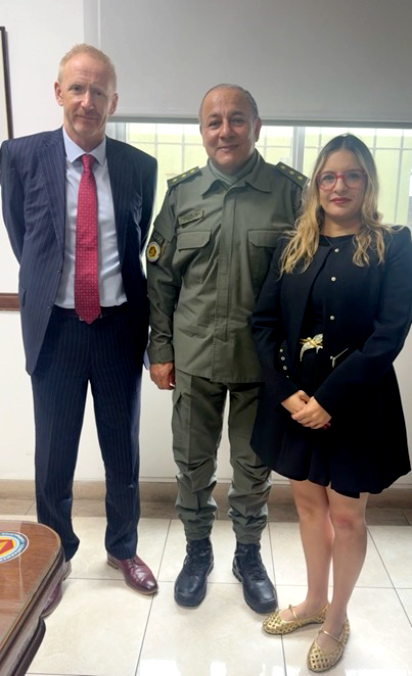
Kevin Mills and Daniela Suárez together with Daniel Aníbal Vázquez, Major Commander, Director of Criminalistics and Forensic Studies of the National Gendarmerie of Argentina.
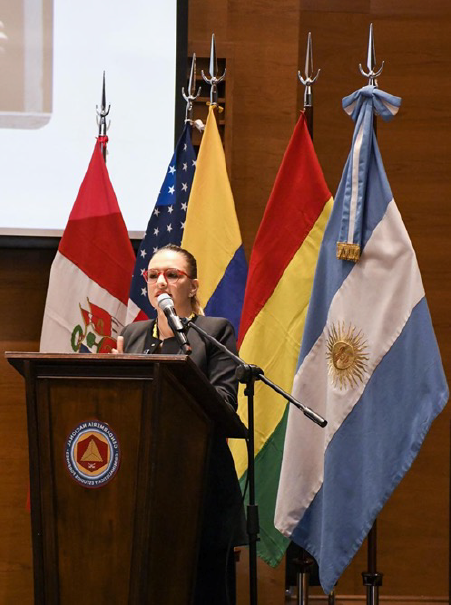
Daniela Suárez presenting at the conference.
 EL SALVADOR
 DOMINICAN REPUBLIC
 URUGUAY
 HONDURAS

 BOLIVIA
 PERU
PERU